By Andris Lagsdin · Founder of Baking Steel
Spelt has been around since the Bronze Age. Long before refined white flour existed, people were milling this ancient grain and making bread with it. There's a reason it's stuck around for thousands of years — it has a nutty, slightly sweet flavor, a higher protein content than standard wheat, and it's generally easier on the gut than modern flour.
I first started playing with spelt dough because a chef friend challenged me on it. I was skeptical. I'm a 72-hour cold ferment guy, that's my process, that's what I teach. But spelt behaves differently than bread flour, and once I understood that, I got hooked.
Here's what you need to know: spelt has a weaker gluten structure than wheat. That's actually a feature, not a bug, it makes the dough more extensible and easier to stretch. But it also means you can't push it as hard. No aggressive kneading. No overworking. Handle it gently and it rewards you.
The result is a pizza crust with real character, a subtle nuttiness, a crispy bottom, and an airy open crumb that you just don't get from straight bread flour. Baked on a Baking Steel, it's exceptional.

The Formula
This is built on the foundation of my 72-hour dough, but we swap 50% of the bread flour for spelt. That ratio is the sweet spot. More spelt and the dough gets too fragile. Less and you lose the flavor.
Because spelt absorbs water differently, we bump hydration from 70% to 73%. That's the adjustment that makes it work.
Makes 3–4 dough balls
- 250g bread flour
- 250g spelt flour
- 16g fine sea salt
- 1g active dry yeast
- 365g water, room temperature
Step-by-Step
1. Mix the dry ingredients. Combine bread flour, spelt flour, salt, and yeast in a large bowl. Whisk to combine.
2. Add water. Pour in the water slowly and mix with a wooden spoon until it comes together.
3. Knead — gently. Turn out onto a lightly floured surface and knead for 2–3 minutes by hand. This is important: don't overwork spelt dough. Hand kneading only the gluten breaks down more easily than wheat and you'll end up with a crumbly mess if you push it.
4. Bulk ferment. Place dough in a covered bowl and let it ferment at room temperature for 24 hours.
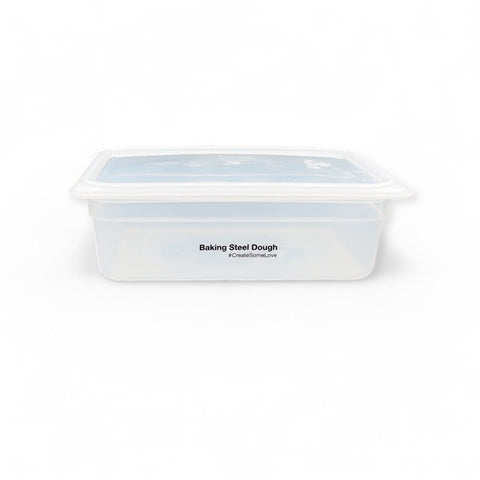
5. Divide and ball. Lightly flour your surface, remove the dough, and divide into equal portions — 220g each for 4 balls, 293g each for 3. Shape each into a tight ball and place in lightly oiled containers. Date them.
6. Cold ferment. Refrigerate for 48 hours minimum. The slow cold ferment is where the flavor develops. Don't rush it.
7. Bring to room temperature. Pull the dough at least 1 hour before baking. It needs to relax before you stretch it. While it's coming up to temp, fire up your oven with your Baking Steel on the top rack, full hour preheat, as hot as it goes.
8. Stretch and bake. Stretch gently to 10–12 inches. Top it simply, spelt dough has enough flavor that it doesn't need to be buried under toppings. Bake on the steel at 500°F, broil first for 1–2 minutes, then bake mode for 3–5 more.
Tips
Keep it simple on top. The spelt flavor is the star. A good sauce, fresh mozzarella, basil. Let the crust speak.
Don't skip the cold ferment. 48 hours in the fridge is what transforms this from good to great. The slow fermentation develops complexity you can't get any other way.
Watch the stretch. Spelt dough is more extensible than standard dough — it'll stretch easily. That's great, but don't push it past 12 inches or you'll get thin spots.
Use semolina on your peel. Always. Especially with a wetter dough like this — it slides clean every time.
Want to Skip the Measuring?
Our 72-Hour Pizza Dough Mix is pre-measured Central Milling organic flour — just add water. It's the same foundation this recipe is built on. Perfect if you want great pizza without the scale.
Frequently Asked Questions
Can you use spelt flour for pizza dough? Yes, spelt makes an excellent pizza dough with a nutty, slightly sweet flavor and a crispy, airy crust. The key is using 50% spelt and 50% bread flour, increasing hydration slightly, and handling it gently. Spelt has a weaker gluten structure than wheat, which makes it easier to stretch but also easier to overwork.
What is the difference between spelt flour and regular flour for pizza? Spelt has a higher protein content and a more complex flavor than all-purpose flour, but a weaker gluten network than bread flour. The result is a more extensible dough that stretches easily and bakes with more character. It's also generally easier to digest than modern wheat.
Is spelt an ancient grain? Yes, spelt has been cultivated since the Bronze Age, making it one of the oldest cultivated grains in the world. It's part of the wheat family but has remained largely unchanged over thousands of years, which is why it's often called an ancient grain.
How long should spelt pizza dough ferment? For best results, 24 hours bulk fermentation at room temperature followed by 48 hours cold fermentation in the refrigerator. The slow cold ferment develops complex flavor that you simply can't get with a same-day dough.
Can I use 100% spelt flour for pizza dough? You can, but it's not recommended for beginners. Pure spelt dough is fragile, hard to handle, and tears easily. A 50/50 blend with bread flour gives you the flavor benefits of spelt with enough structure to work with.
What hydration should spelt pizza dough be? Around 73% hydration works well for a 50/50 spelt and bread flour blend. Spelt absorbs water differently than standard wheat flour, so you need slightly more water than a typical bread flour dough.